Warehouse and fulfillment operations are under pressure to move more items, use less energy, and keep systems running with fewer interruptions. For many operators, the solution is not a complete rebuild. It is a smarter upgrade strategy that improves material flow step by step. Modern energy-efficient conveyor systems and sorters help reduce unnecessary motion, improve throughput, and lower lifecycle costs. The strongest results often come from combining modular conveyor technology, decentralized drives, intelligent controls, right-sized sortation, and predictive maintenance.
Why energy efficiency now matters in warehouse automation
Energy efficiency is no longer only a sustainability topic. It is a performance and cost-control topic.
Older conveyor systems often run continuously, even when no goods are present. This increases energy use, mechanical wear, and maintenance needs. Modern conveyor platforms use zone-based control, allowing motors to run only when products need to move.
That means warehouses can improve throughput while reducing waste. For system integrators and end users, the key question becomes: how much energy does the system use per item handled?
Modular conveyor platforms: the foundation for scalable upgrades
A modular conveyor platform is often the best starting point for modernization. Interroll’s Modular Conveyor Platform, MCP, connects roller conveyors, belt conveyors, curves, merges, lifters, and diverts in one scalable system.
For system integrators, this reduces engineering complexity and supports faster project execution. For end users, it enables future expansion, layout changes, and phased upgrades without redesigning the entire system.
In brownfield facilities, where space is limited and operations cannot stop for long, this modularity is especially valuable.
Decentralized drives and zero-pressure accumulation
One of the most effective ways to reduce conveyor energy consumption is to move from centralized drives to decentralized motor rollers.
Interroll RollerDrive EC5000 places the motor inside the roller, supporting compact conveyor design and zone-based activation. Motors run only where goods are present, helping reduce energy use and wear.
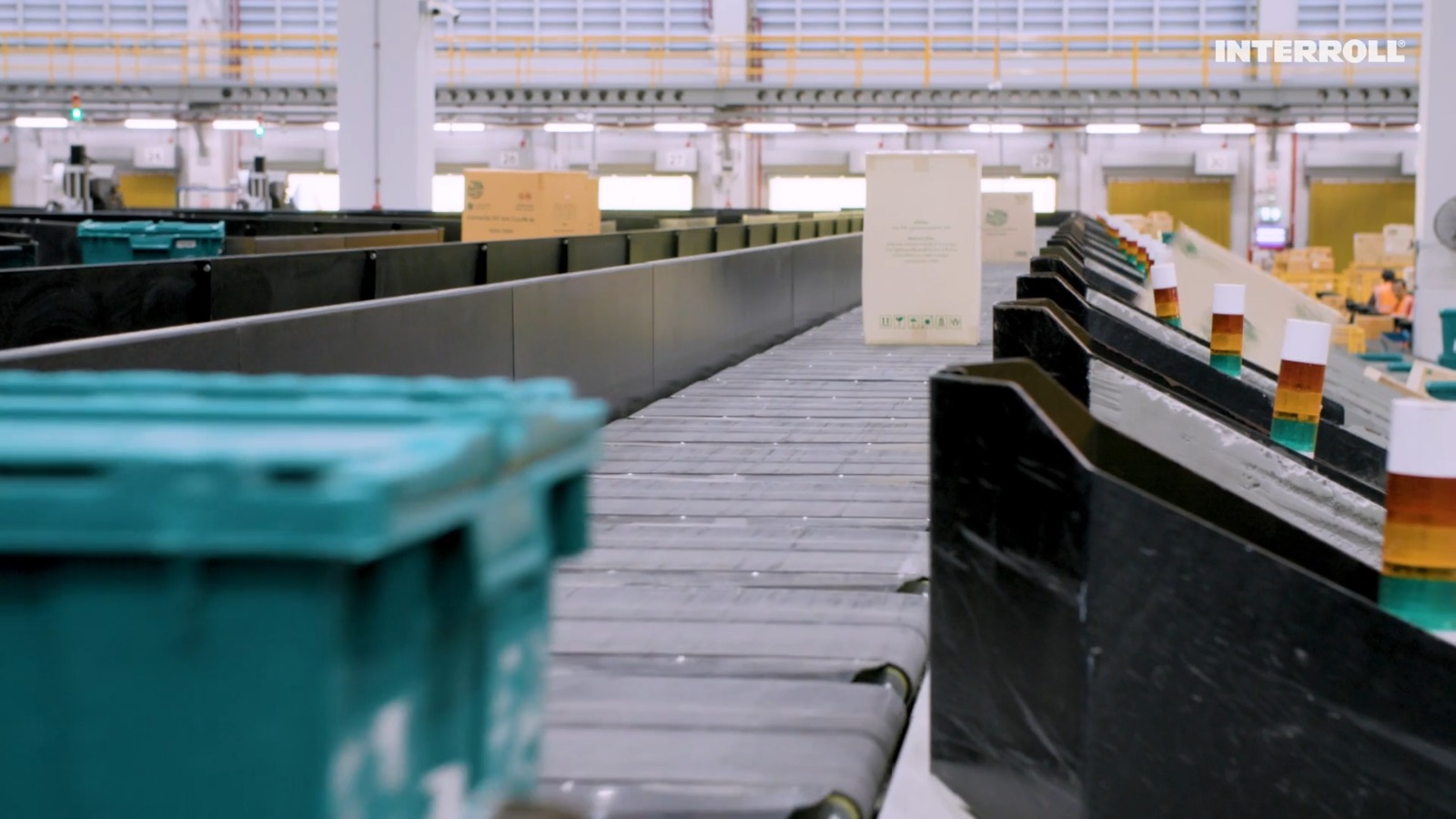
Combined with zero-pressure accumulation, products can queue without contact. This protects goods, prevents jams, and avoids running conveyor zones unnecessarily. The result is smoother flow with less wasted motion.
Sorters should be matched to the application
Energy-efficient automation also depends on choosing the right sorter for the job.
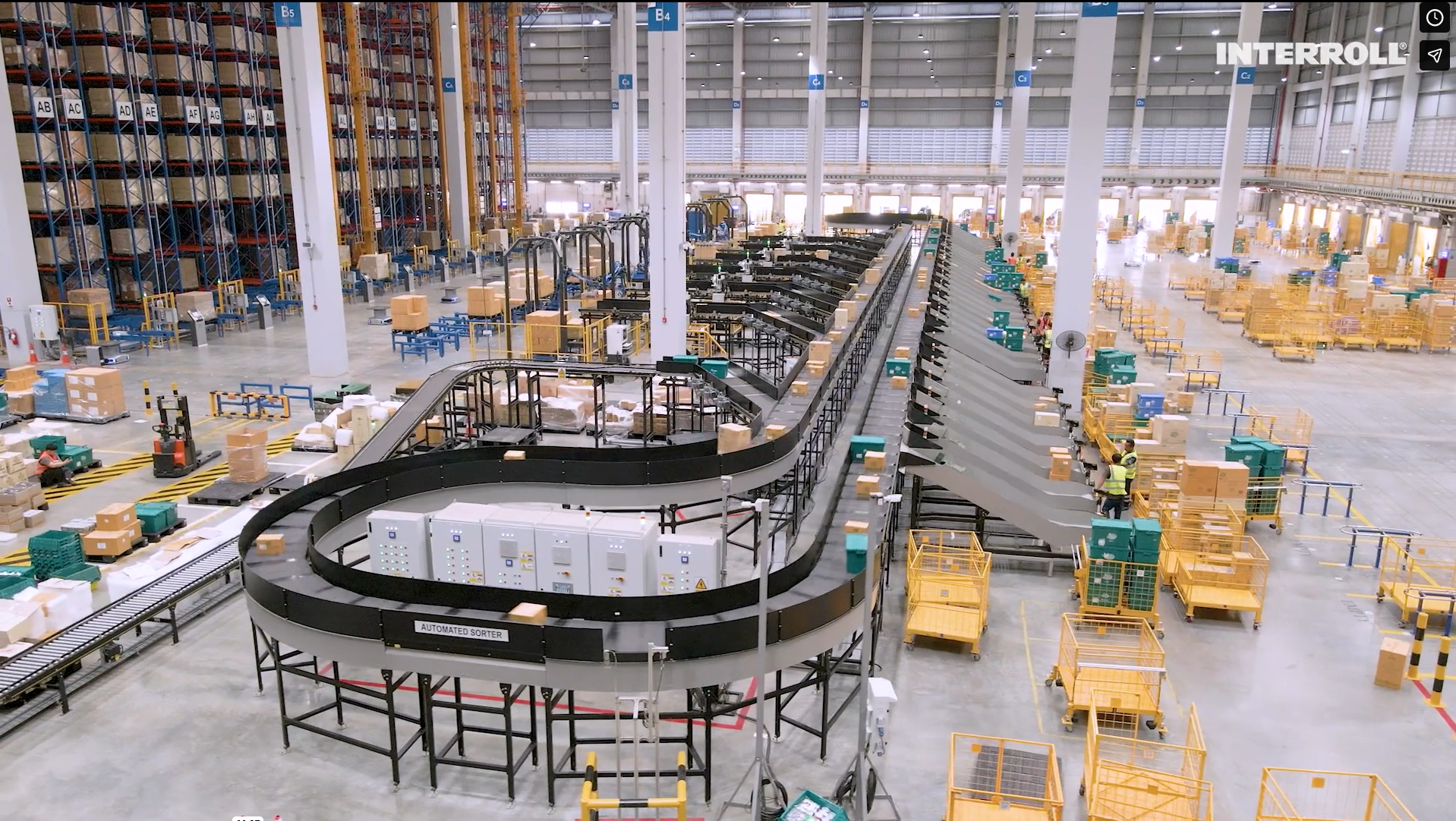
Large e-commerce and parcel hubs still need high-performance systems that can handle peak throughput with reliable operation. Interroll’s MX-H Horizontal Crossbelt Sorter supports demanding high-volume environments, while the MX-V Vertical Crossbelt Sorter helps increase sorting capacity where floor space is limited.
For regional hubs, last-mile facilities, and brownfield projects, right-sized automation is often the better fit. Interroll’s Sortteq Modular ChainBelt Sorter MC-S supports mid-performance sortation where compact footprint, mixed-item handling, and easier integration are priorities.
For targeted flow control, HPD and MBS can help automate local diverting and medium-throughput routing without moving directly to a full sorter investment.
Controls and maintenance complete the efficiency story
Mechanical upgrades alone are not enough. Intelligent controls, simplified commissioning, and system visibility are essential for efficient operation.
Controls help reduce unnecessary motion, coordinate zones, and improve diagnostics. Predictive maintenance adds another layer of value by detecting issues such as overload, vibration, heat, or unusual current draw before they cause downtime.
This is especially important in high-volume fulfillment and parcel operations, where small interruptions can quickly affect service levels.
Conclusion
Energy-efficient conveyor and sorter upgrades are no longer just about using less power. They are about building smarter, more resilient material flow.
By combining modular conveyor platforms, decentralized drives, zero-pressure accumulation, right-sized sortation, intelligent controls, and predictive maintenance, warehouses can increase throughput while reducing energy waste and lifecycle costs.
For modern fulfillment, parcel, and distribution operations, the most effective automation strategy is clear: use the right technology, in the right zone, at the right level of performance.


.png?width=164&height=232&name=Sortation%20Portoflio%20carousel%20(1).png)

.png?width=2560&height=1440&name=image%20(3).png)
.jpg?width=4905&height=3270&name=DSC01633%20(1).jpg)