
Meet the Drum Motor: Washdown Conveying Without the Maintenance Complexity in Food Processing Industry
by Sandeep Chakreborty on Sep 21, 2026, 1:08:08 PM
New Production Facility for Motors & Drives: Improving Efficiency | Interroll India
The cost of a conveyor drive in a food plant is not paid on the day it is installed. It is paid over years of shifts, washdowns, audits and maintenance windows.
That is why a datasheet tells you very little about how a drive will behave on your line. The better test is to follow it through its working life and ask, at each stage, how much attention it demands.
Here is what that looks like for a Drum Motor.
Day one: installation
A Drum Motor is a conveyor drive with the motor, gearbox, and bearings built inside the roller itself. There is no separate motor to mount beside the frame, no chain or coupling to connect it, and no guard to fit around the moving parts. The drive is the roller. It sits inside the conveyor frame and turns the belt directly.
On installation day, that changes the job. Fewer parts arrive, fewer parts are fitted, and there is no drive alignment to get right before the belt runs true. The space beside the conveyor that an external motor would occupy stays clear, which matters in packing and processing areas where clean clearance is already tight.
For an integrator, that is a shorter commissioning window. For a plant, it is a line that goes live with less to checkM
The first washdown
Food lines are cleaned hard and cleaned often. Water, foam, chemicals, and high-pressure, high-temperature rinses reach every surface a sanitation crew can point a hose at.
An external drive is not designed for that. Its exposed bearings, cable entries and gearbox seams are exactly where water finds a way in, and the damage rarely shows until a bearing fails weeks later.
A Washdown Drum Motor is built for the wash cycle rather than around it. Selected configurations are manufactured entirely in stainless steel, hermetically sealed, and rated IP66 and IP69K for high-pressure, high-temperature washdown. The surface presented to the crew is a smooth cylinder with no brackets, fins or crevices to reach around. Nothing has to be removed before cleaning and nothing has to be refitted afterwards.
The first washdown is where most drive problems begin. For a Drum Motor it is simply part of the shift.
Month six: the audit
Clean audits look closely at drive areas, because that is where residue collects and where design shortcuts show. Ledges, exposed fasteners and hard-to-reach corners all become findings.
A Washdown Drum Motor removes most of them by design. Cleanable configurations meet EHEDG equipment design criteria, follow the Ecolab cleaning procedure, and comply with FDA and EU EC 1935/2004 food-contact regulations. The enclosed construction gives an auditor fewer places to question and a quality team fewer places to defend.
Compliance is easier to demonstrate when the design does the demonstrating.
The stop that does not happen
Unplanned downtime in food production has a particular cost. A single component failure can halt an entire line, and every hour lost is product not packed and orders not shipped.
Most unplanned drive failures trace back to the same exposed components: a slipped chain, a worn coupling, a bearing that took on water. Enclose them, and the failure points that generate most emergency call-outs are no longer there.
A drive with fewer ways to fail is a line with fewer reasons to stop.
When something does need attention
No drive runs forever, and a low-maintenance design is only as good as the support behind it when attention is finally needed.
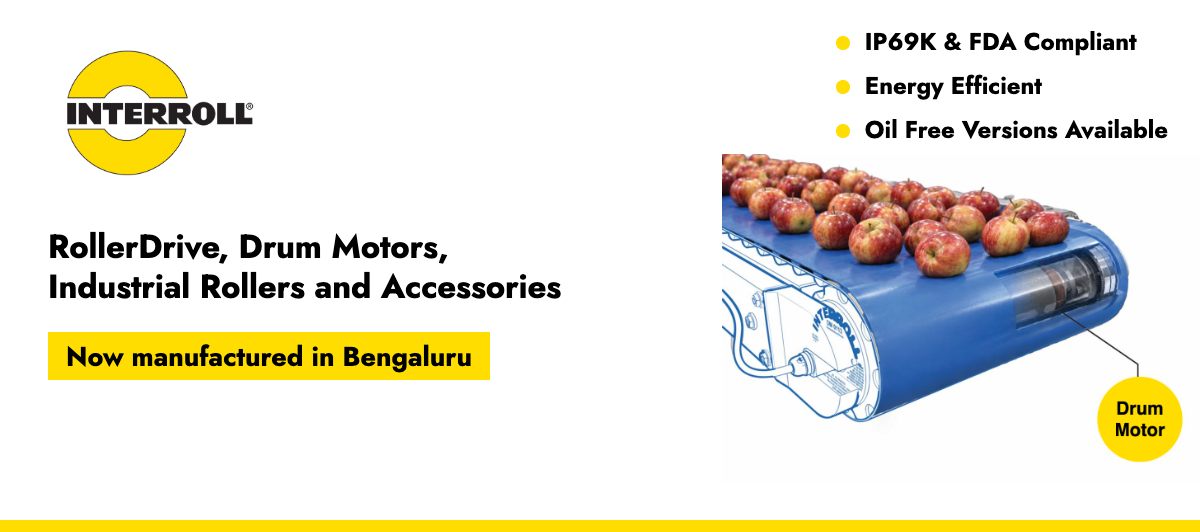
Drum Motors are now manufactured at the Interroll facility in Bangalore, alongside RollerDrive and MCP modules. That puts spare parts, service and engineering support in India, with delivery timelines measured in weeks rather than the months an import cycle required. Selecting the right model and configuration for a specific belt, load and washdown regime is a conversation that now happens locally.
A drive designed to run untouched should not wait on a customs queue when it does need a hand.
What the lifecycle view changes ?
Judged on installation day alone, an external motor and a Drum Motor can look like comparable options. Judged across five years of washdowns, audits and maintenance windows, they are not the same product.
The Drum Motor wins that comparison by subtraction. Fewer parts to fit, fewer surfaces to clean, fewer entries in the maintenance log, fewer ways to stop the line, and less energy drawn along the way. For food processors, that is the practical meaning of washdown conveying without the maintenance complexity.
Frequently asked questions
How is a Drum Motor different from an external gear motor? An external gear motor is mounted beside the conveyor and connected through a chain or coupling. A Drum Motor integrates the motor, gearbox and bearings inside the roller that drives the belt, so those external components are not needed.
Can it be installed on an existing food line? Yes. Because the drive sits inside the conveyor frame, it suits both new lines and brownfield upgrades where an existing belt conveyor is being modernised.
What washdown conditions can it handle? Selected configurations are rated IP66 and IP69K, which covers high-pressure and high-temperature washdown, and are manufactured in stainless steel for cleanable environments.
Which food hygiene standards does it meet? Cleanable configurations meet EHEDG design criteria, follow the Ecolab cleaning procedure, and comply with FDA and EU EC 1935/2004 food-contact regulations.
What routine maintenance is required? Very little. With the gearbox and bearings sealed inside the shell, there is no chain tensioning, oil change, coupling alignment or guard removal in the routine schedule.
Is it manufactured and supported in India? Yes. Drum Motors are manufactured at the Interroll facility in Bangalore, with local service, spare parts and engineering support.
Consult an expert: Talk to the Interroll India team about the right Drum Motor for your line.
Explore: Drum Motors and Food and Beverage solutions.
Download the leaflet
Discover how Interroll’s locally assembled Drum Motors in India combine global quality with faster delivery, regional support and optimized pricing. Download the leaflet to explore the key benefits and specifications.